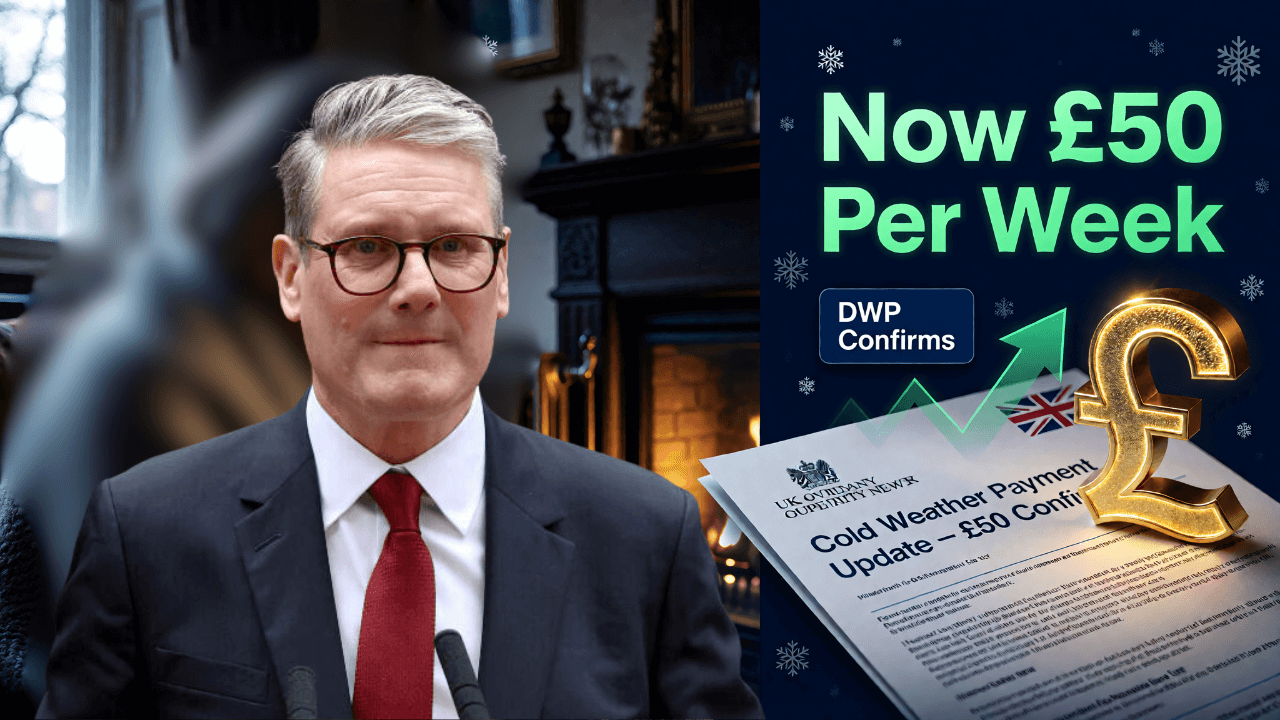
As freezing temperatures continue to affect parts of the UK, the Department for Work and Pensions has confirmed that Cold Weather Payments will increase to £50 per qualifying cold spell in eligible areas. The announcement comes as many households face rising winter energy bills, placing extra strain on those already managing tight budgets.
For people on certain benefits, this change could provide meaningful short‑term relief during periods of prolonged cold. But who qualifies? Is it automatic? And how does the £50 payment actually work?
Here is a full and clear breakdown of what the updated Cold Weather Payment means and who can expect to receive it.
What Is the Cold Weather Payment
The Cold Weather Payment is a government scheme designed to help vulnerable households with additional heating costs during periods of very cold weather.
It operates between November and March each year and is triggered automatically when the temperature in your area meets specific criteria.
The scheme is administered by the Department for Work and Pensions.
Unlike general winter support payments, Cold Weather Payments are conditional. They depend entirely on weather data linked to specific local weather stations.
How the £50 Payment Works
Previously, the payment stood at £25 for each qualifying seven‑day period of freezing temperatures. Under the updated arrangement, that amount has doubled to £50 per qualifying period.
The trigger is straightforward:
If the average temperature in your area is recorded or forecast to be zero degrees Celsius or below for seven consecutive days, a Cold Weather Payment is activated.
Each separate qualifying cold spell results in a separate payment.
This means that if your area experiences two qualifying cold spells during winter, you could receive £100. If there are three, that would total £150.
There is no cap on the number of payments per season — it depends entirely on the weather.
Who Is Eligible for the £50 Payment
Not everyone receiving benefits qualifies automatically. Eligibility depends on receiving specific qualifying benefits.
You may qualify if you receive:
Pension Credit
Or certain elements of:
Universal Credit
In addition, people receiving the following may also qualify:
Income Support
Income‑based Jobseeker’s Allowance
Income‑related Employment and Support Allowance
In many cases, additional conditions apply — such as having a disability element, a child in the household or limited capability for work status.
Eligibility rules can be detailed, so individual circumstances matter.
Pensioners and the Cold Weather Payment
Pensioners receiving Pension Credit are among the most likely to qualify automatically.
For older households, keeping homes adequately heated during freezing temperatures is especially important for health and wellbeing.
The increase to £50 per cold spell could provide additional reassurance during prolonged cold snaps.
It is worth noting that pensioners who do not receive Pension Credit may not automatically qualify.
Universal Credit Claimants
If you receive Universal Credit, you may qualify if your award includes:
A health condition or disability element
A child element
Limited capability for work
Universal Credit claimants without these components may not be eligible for Cold Weather Payments.
This is one of the most common areas of confusion.
Do You Need to Apply
In most cases, you do not need to apply.
If you are eligible and your area experiences a qualifying cold spell, the payment is made automatically.
It will usually be paid into the same bank account where you receive your regular benefits.
Payments are typically made within 14 working days of the qualifying cold spell ending.
If you believe your area qualified and you did not receive payment, you can contact the appropriate helpline for clarification.
How Temperature Is Measured
Cold Weather Payments are linked to designated weather stations across the UK.
Each postcode is assigned to a specific station. If that station records or forecasts an average temperature of zero degrees or below for seven consecutive days, the payment is triggered.
Because it is postcode‑based, some areas may receive payments while neighbouring areas do not.
This regional variation can sometimes cause confusion.
How to Check If Your Area Has Triggered
The government provides an official online postcode checker.
By entering your postcode, you can:
See whether your area has triggered a Cold Weather Payment
Check historical cold spell data
Confirm whether payment should be expected
This tool offers clarity and avoids unnecessary worry.
Difference Between Cold Weather Payment and Winter Fuel Payment
It is important not to confuse Cold Weather Payments with the Winter Fuel Payment.
The Winter Fuel Payment is typically a fixed annual payment for eligible pensioners, regardless of actual temperatures.
Cold Weather Payments, by contrast, are conditional and depend entirely on local weather data.
You may qualify for both schemes if you meet the criteria.
Why the Payment Has Increased
The doubling of the Cold Weather Payment reflects ongoing concern about rising energy costs and winter hardship.
Heating expenses remain significantly higher than they were several years ago.
For low‑income households, even a small increase in heating usage can push budgets to the limit.
Increasing the payment to £50 per qualifying period aims to provide stronger short‑term support when temperatures drop sharply.
How Much Could You Receive This Winter
The total amount depends entirely on how many qualifying cold spells occur in your area.
For example:
One cold spell = £50
Two cold spells = £100
Three cold spells = £150
In particularly harsh winters, the total could be higher.
However, mild winters may result in no payment at all.
Is the Payment Taxable
The Cold Weather Payment is not taxable.
It does not affect your other benefits and is not counted as income.
This means you receive the full £50 per qualifying week without deductions.
What If Temperatures Fluctuate
The seven‑day period must be consecutive.
If temperatures dip below zero for several days but then rise above zero before reaching seven consecutive days, the sequence resets.
Only full seven‑day qualifying periods trigger payment.
Short cold snaps may not meet the threshold.
Other Support Available
Cold Weather Payments are only one part of winter support.
Other schemes may include:
Warm Home Discount
Local council hardship funds
Energy supplier support programmes
Each scheme has its own eligibility criteria.
Checking what support is available locally can provide additional assistance.
Common Misunderstandings
Many people assume:
Everyone on benefits receives it
It is paid automatically every winter
It replaces other winter support
In reality:
Eligibility depends on specific benefit types
It only triggers during qualifying cold spells
It operates separately from other schemes
Understanding the structure prevents confusion.
Why This Matters Now
Winter energy costs remain a significant concern for households across the UK.
While temperatures may vary regionally, sudden cold spells can lead to higher heating usage.
The increase to £50 per qualifying period provides more substantial support during those specific weeks when energy demand is highest.
For vulnerable households, timely assistance can reduce the risk of falling into arrears.
Key Points to Remember
The payment is £50 per qualifying seven‑day cold spell.
It is triggered automatically by local temperature data.
Eligibility depends on specific benefits.
Multiple payments are possible in one winter.
No application is required if you qualify.
Final Thoughts
The confirmation that Cold Weather Payments have doubled to £50 per qualifying cold spell offers reassurance to many low‑income households facing the realities of winter.
While it is not a universal payment and depends on specific eligibility and weather conditions, the increased amount reflects the higher cost of heating and the need for targeted support.
If you receive qualifying benefits, you do not need to take action unless you believe a payment has been missed. Checking your postcode and understanding your entitlement can provide peace of mind.
During cold periods, practical support matters. Knowing how and when it is triggered helps ensure you receive everything you are entitled to this winter.